


Page 59 - Demo
P. 59
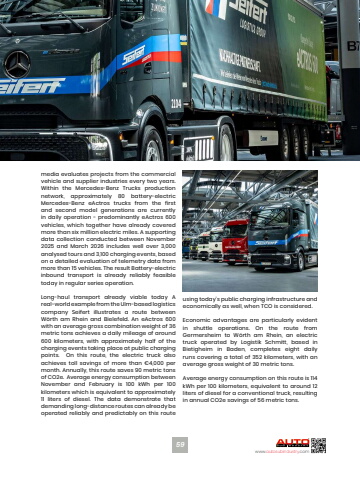
59 www.autosubindustry.commedia evaluates projects from the commercial vehicle and supplier industries every two years. Within the Mercedes%u2011Benz Trucks production network, approximately 80 battery-electric Mercedes%u2011Benz eActros trucks from the first and second model generations are currently in daily operation - predominantly eActros 600 vehicles, which together have already covered more than six million electric miles. A supporting data collection conducted between November 2025 and March 2026 includes well over 3,000 analysed tours and 3,100 charging events, based on a detailed evaluation of telemetry data from more than 15 vehicles. The result Battery-electric inbound transport is already reliably feasible today in regular series operation.Long-haul transport already viable today A real-world example from the Ulm-based logistics company Seifert illustrates a route between W%u00f6rth am Rhein and Bielefeld. An eActros 600 with an average gross combination weight of 36 metric tons achieves a daily mileage of around 600 kilometers, with approximately half of the charging events taking place at public charging points. On this route, the electric truck also achieves toll savings of more than %u20ac4,000 per month. Annually, this route saves 90 metric tons of CO2e. Average energy consumption between November and February is 100 kWh per 100 kilometers which is equivalent to approximately 11 liters of diesel. The data demonstrate that demanding long-distance routes can already be operated reliably and predictably on this route using today%u2019s public charging infrastructure and economically as well, when TCO is considered.Economic advantages are particularly evident in shuttle operations. On the route from Germersheim to W%u00f6rth am Rhein, an electric truck operated by Logistik Schmitt, based in Bietigheim in Baden, completes eight daily runs covering a total of 352 kilometers, with an average gross weight of 30 metric tons. Average energy consumption on this route is 114 kWh per 100 kilometers, equivalent to around 12 liters of diesel for a conventional truck, resulting in annual CO2e savings of 56 metric tons.


