


Page 115 - Demo
P. 115
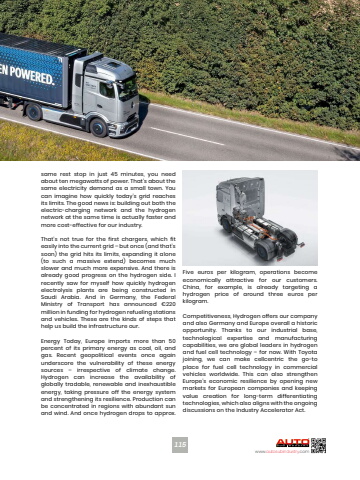
115 www.autosubindustry.comsame rest stop in just 45 minutes, you need about ten megawatts of power. That%u2019s about the same electricity demand as a small town. You can imagine how quickly today%u2019s grid reaches its limits. The good news is: building out both the electric-charging network and the hydrogen network at the same time is actually faster and more cost-effective for our industry. That%u2019s not true for the first chargers, which fit easily into the current grid %u2013 but once (and that%u2019s soon) the grid hits its limits, expanding it alone (to such a massive extend) becomes much slower and much more expensive. And there is already good progress on the hydrogen side. I recently saw for myself how quickly hydrogen electrolysis plants are being constructed in Saudi Arabia. And in Germany, the Federal Ministry of Transport has announced %u20ac220 million in funding for hydrogen refueling stations and vehicles. These are the kinds of steps that help us build the infrastructure our. Energy Today, Europe imports more than 50 percent of its primary energy as coal, oil, and gas. Recent geopolitical events once again underscore the vulnerability of these energy sources %u2013 irrespective of climate change. Hydrogen can increase the availability of globally tradable, renewable and inexhaustible energy, taking pressure off the energy system and strengthening its resilience. Production can be concentrated in regions with abundant sun and wind. And once hydrogen drops to approx. Five euros per kilogram, operations become economically attractive for our customers. China, for example, is already targeting a hydrogen price of around three euros per kilogram. Competitiveness, Hydrogen offers our company and also Germany and Europe overall a historic opportunity. Thanks to our industrial base, technological expertise and manufacturing capabilities, we are global leaders in hydrogen and fuel cell technology %u2013 for now. With Toyota joining, we can make cellcentric the go-to place for fuel cell technology in commercial vehicles worldwide. This can also strengthen Europe%u2019s economic resilience by opening new markets for European companies and keeping value creation for long-term differentiating technologies, which also aligns with the ongoing discussions on the Industry Accelerator Act.


